Sunday, July 11, 2010

July 10 photo of the day

Always lots of drama in the front yard birdie spa. I have two bird feeders with black sunflower seeds in my ornamental plum tree, and two hummingbird feeders on the porch right outside my studio window. Mostly finches - gold, house, purple - pine siskins, evening grosbeaks, an occasional mourning dove. Last summer, I looked out to find a dozen red-winged blackbirds cleaning out the feeders. There's also a neighborhood cat that knows that the birds get complacent and feed on the ground below the feeders. One gets picked off about once a week.

I attribute the tree's job of hosting dozens of birds a day to its healthiness. Most of the houses on my street have ornamental plums in the front yard. Mine is the tallest and has the largest diameter trunk of any of the plums planted in 2005 when these houses were built.

This guy getting a drink (and very aware that I am watching him) is a purple finch. They look almost identical to house finches but are more of a rosy red, have a splash of red at the base of the tail, and almost a crest that pops up on the top of their heads. He blends in with the wine & roses weigela surrounding the birdbath.

Friday, July 9, 2010

July 8 photo of the day


So, does it count as a photo a day if I shoot it but it takes me a day or two to get it out of my camera? Ok, I actually have missed two days this week. I'll make up for it this weekend. It has been unusually hot here in western Washington. It was 95 yesterday and 91 today. I waited until almost sundown to walk the dog. I had to douse myself with bug spray to survive the mosquito onslaught. Ridgeview Trail in DuPont has an official on-the-map section and an unofficial section that hasn't been fully developed to get rid of all of the things that trip people up. Everybody uses the trail anyway because it has spectacular view. An example is on my website - a panoramic of sunset over the Olympic Mountains and Puget Sound. That image was photographed almost one year ago to the day from the one I am posting for my July 8 photo. This is photographed from the "unofficial" section of trail which is on the perimeter road for the former DuPont explosives factory, now a golf course.

Tuesday, July 6, 2010

July 6 photo of the day


Young mallard pretending to be a pterodactyl. Anything for a handout! This was at Tumwater Pioneer Park where visitors are discouraged from feeding ducks, which have plenty to eat in the Deschutes River anyway. Others in the series are on Facebook.

Monday, July 5, 2010

July 5 - a perfect rose


The rest of the rose plant doesn't look so great and this is one of two buds. I love roses but seem to do better photographing them than growing them. I tried several views, including one where both the rose and the garden ornament are in focus. I liked this one best.

July 4th-get up close


This is the first time in a very long time that I wasn't actually working on July 4th. I took the dog for a walk in the woods before the boomers started (fireworks are allowed for three days over July 4th weekend) and found a few close-up opportunities.

The first is a common wildflower called "candy flower" or "Siberian miner's lettuce" (Claytonia sibirica). My favorite lens is a 28-105 zoom that also has a macro feature. The macro sometimes sticks, which is probably why Nikon doesn't make this lens anymore...or at least I haven't found it. I bought this one about 20 years ago. I photographed this image at 640 ISO at 75mm with a fill flash. Here is the full frame.

When I pulled it into first Adobe Lightroom, and then Adobe Photoshop to edit, I decided to crop tight to the leaves and flowers. I corrected the color balance but a bit too far to the warm end of the color spectrum Then I spotted a dewdrop that I didn't see when I photographed the flower. I corrected the color balance again and sharpened the image a bit more. The graininess comes from shooting at a higher ISO in low light.

Later in the walk, I spotted some insects on a blackberry blossom. This time I used the macro feature on the lens at available light, but still at 640 ISO.

Saturday, July 3, 2010

Photo a Day


I was inspired by NYC (formerly of Phoenix) photographer Bob Carey to post a photo a day. Since I'm a few days behind in my editing (aHEM!), I'm going to post my favorite images from the past four days.

OK, I'm cheating a little. The baby house finch and sunset photos were both shot the evening of June 28, 2010.


The crocosmia and lavender were photographed early morning July 2, 2010. The honeybee on the flower was photographed July 3, 2010.

Saturday, October 3, 2009

Photography - raw magic


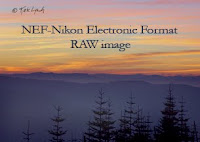
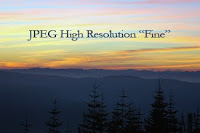
Here are two examples of the same image of a sunset taken from Mount St. Helens National Monument. One was edited from a "fine jpeg" image captured at 300 dpi but in jpeg format. The other was edited from NEF, Nikon's raw format (Nikon Electronic Format).

There was a time, not so long and far away, when photographers had to know a little about design, composition, chemistry, and maybe a little alchemy. I spent many hours photographing, then "souping" film, letting it dry, carefully cutting the newly emerged negatives into strips, and slipping them into protective sleeves. Black-and-white photo printing was always a magical experience for me, watching images as they emerged in a tray of developer.

With digital photography, I once again feel the magic I experienced in the darkroom with black-and-white images. I still spend many hours photographing and editing images. Now, instead of souping film and making images emerge in a darkroom, I work in a "lightroom" on my computer.

A misconception people have is that digital photography is faster and easier than film photography. I often have conversations with customers and friends who think that because I use digital photography equipment that all I have to do is download the photos and print them out. In reality, it probably takes me 2-3 times longer to edit photographs than the actual photo shoot. For most clients, I burn a CD or DVD with 100 images in different formats and print a custom label. I also print out proof sheets (we call them contact sheets in film photography) so the client can see what is on the CD. For a typical one-hour portrait session, I will devote another 3-4 hours to produce a quality product.

High-end digital cameras capture images in "raw" format. Wikipedia has a great definition of raw format: A camera raw image file contains minimally processed data from the image sensor of a digital camera or scanner. Raw image files are sometimes called digital negatives, as they fulfill the same role as negatives in film photography. The negative is not directly usable as an image, but has all of the information needed to create an image.

The advantage of capturing images in raw format is that it faithfully records 100 percent of what a camera and the photographer see. I open a file of "digital negatives" and quickly scan them in Adobe Lightroom to decide which are the best images. Then I go through each image and adjust the color balance, contrast, and sharpen the images. Sometimes I will export the image to Adobe PhotoShop for additional editing. For example, some images are very contrasty with extreme light and dark areas. In the film darkroom, while exposing photo paper with a negative in an enlarger, we would "dodge" areas to make them lighter or "burn" areas to make them darker. The same kind of adjustment can be made in PhotoShop.